Ford G.O.A.T. Modes & Terrain Management | Fremont Ford Cody
What is GOAT Mode on a Ford?
Master Wyoming Terrain with Ford G.O.A.T. Modes
Discover how the full-size Ford Bronco, compact Bronco Sport, and Ford truck lineup deliver ultimate off-road control across Cody, Worland, and the Bighorn Basin.
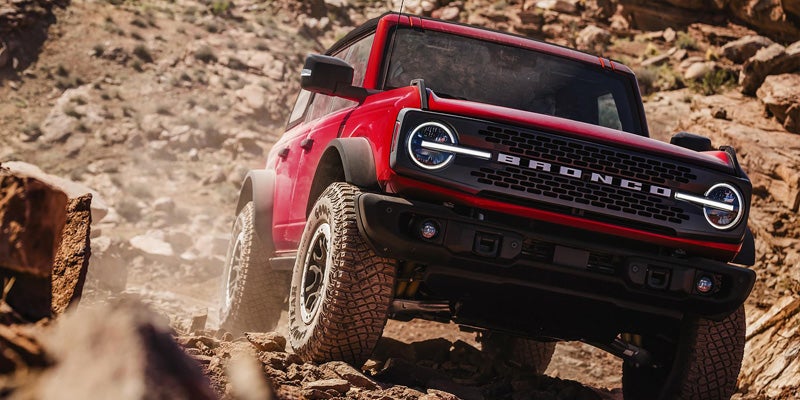
Ford equips the full-size Ford Bronco SUV and the compact Ford Bronco Sport crossover with factory G.O.A.T. Modes as standard equipment. While trucks like the Ford Maverick Tremor, Ford F-150, and Ford F-150 Raptor utilize Ford’s Terrain Management System or specialized drive modes rather than full multi-mode G.O.A.T. branding, they deliver similar surface-specific calibration for off-road driving.
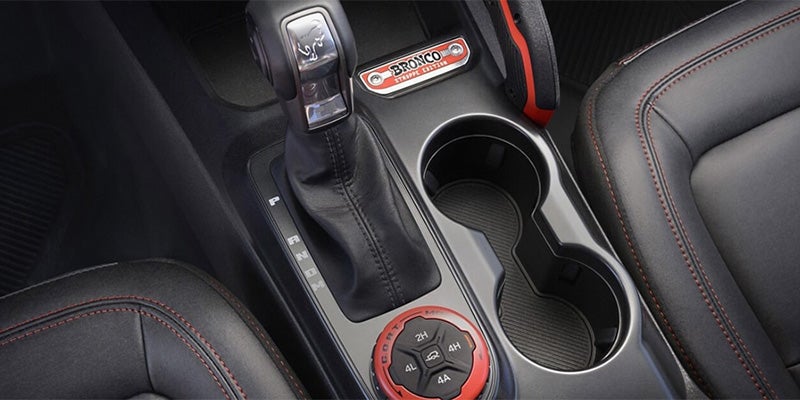
Every modern Ford Bronco model includes a center console rotary dial that activates selectable drive modes. The standard lineup on the Ford Bronco includes trims like the Big Bend, Outer Banks, Badlands, and Raptor. Drivers tackling dirt access roads near the Yellowstone River around Laurel often look for SUV platforms with built-in terrain controls, and the Bronco family delivers that versatility across every model year.
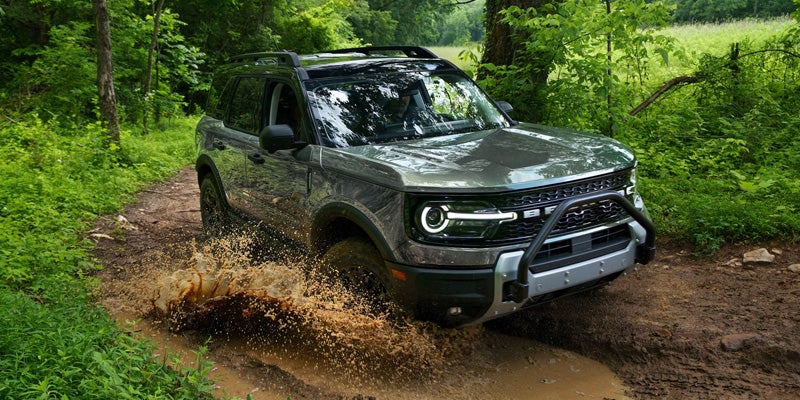
The Ford Bronco Sport delivers G.O.A.T. Mode capability in a compact footprint. Models like the Big Bend, Heritage, Outer Banks, and Badlands feature the system as standard hardware. The Badlands trim adds advanced off-road settings and dual-clutch rear drive units for increased traction on steep or loose gradients.
FORD TERRAIN MANAGEMENT SYSTEMS
Ford BRONCO / BRONCO SPORT
Ford F-150 / MAVERICK / LIGHTNING
• Branded G.O.A.T. Modes
• Terrain Management System
• Rotary Console Dial
• Drive Mode Selectors
• Auto 4x4 / Locker Prompts
• Specialized Tow/Haul & Off-Road Modes
Other vehicles in the lineup offer specialized drive profiles engineered for specific tasks. The Ford F-150 Lightning features dedicated settings such as Tow/Haul and Off-Road that optimize electric torque and disable One-Pedal Drive for smoother pedal modulation over obstacles. To explore these capability features in person, check out our new Ford inventory online, or visit our showroom address on Big Horn Ave. You can also reach our sales department directly by calling (307) 587-6206 to confirm feature availability across specific trim levels.
What Is GOAT Mode on a Ford Vehicle and What Does G.O.A.T. Stand For?
G.O.A.T. stands for "Goes Over Any Type of Terrain," an electronic terrain management system developed by Ford that reconfigures key vehicle systems through pre-set drive modes. By rotating a central dial, the driver instantly adjusts throttle mapping, transmission shift thresholds, traction control sensitivity, electronic stability control, and four-wheel-drive engagement.
The term G.O.A.T. originated during the development of the original 1966 Ford Bronco, where engineers aimed to build an all-purpose vehicle capable of navigating any off-road scenario. Modern engineering brings that philosophy into the digital era by linking multiple vehicle control modules into unified drive profiles.
Selecting a G.O.A.T. Mode changes how the vehicle responds to driver inputs. On-road modes optimize efficiency and stability:
Normal: Balances acceleration, gear shifts, and steering weight for daily street driving.
Eco: Softens throttle sensitivity and adjusts shift points to maximize fuel economy.
Slippery: Reduces throttle sensitivity and tunes traction control to minimize wheel slip on ice, slush, or wet pavement.
Off-road modes alter mechanical and software calibrations for loose surfaces:
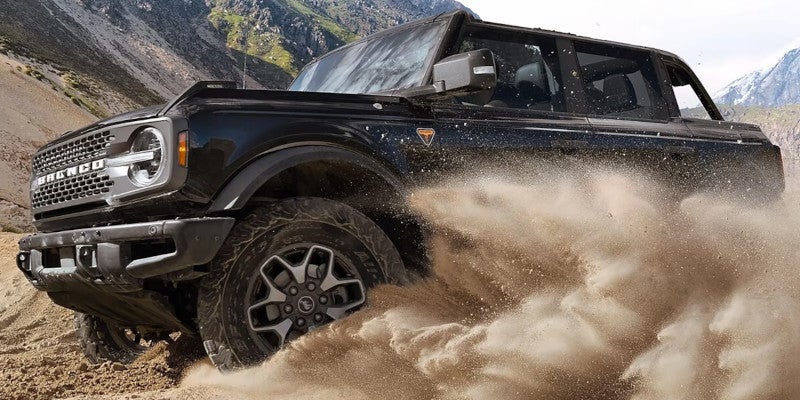
Sand: Tailors throttle delivery and holds momentum to navigate soft, deep surfaces.
Mud/Ruts: Enhances wheel spin allowance, holds lower transmission gears, and engages four-wheel-drive high range (4H).
Rock Crawl: Engages four-wheel-drive low range (4L), locks differential hardware on equipped trims, and slows throttle sensitivity for precise low-speed maneuvering.
Baja: Calibrates high-speed off-road throttle and gear holds for open desert driving.
In Worland, where ranchers and outdoor enthusiasts navigate agricultural soil and loose gravel tracks in the Bighorn Basin, having modes like Mud/Ruts provides predictable traction without manual guessing. Finding these features on pre-owned utility vehicles is straightforward when browsing our pre-owned vehicle inventory.
How Do GOAT Modes Work While Driving and Do They Change 4x4 Settings Automatically?
When comparing off-road systems, Jeep's Selec-Terrain offers unique features for beginners. Modes allow drivers to switch settings while driving at normal speeds by rotating the console-mounted dial, which automatically reconfigures four-wheel-drive modes like 4H or 4L depending on the selected profile. Shifting into low-range modes like Rock Crawl requires stopping the vehicle and shifting the transmission into neutral to allow physical gear transfer case engagement.
When rotating the center dial while moving on asphalt or dirt roads, software alters electronic stability control boundaries and throttle curves in real time. Switching from Normal to Slippery immediately dampens throttle response without requiring the driver to slow down or stop.
G.O.A.T. MODE ENGAGEMENT STEPS
1. Rotate Console Dial
Adjusts Throttle & Steering Maps in real time while driving.
2. On-Road / 4H Modes
Engages automatically while moving at normal speeds.
3. 4L / Rock Crawl Mode
Requires full stop and shifting transmission to Neutral (N).
Automated transfer case switching occurs when selecting off-road profiles. Choosing Mud/Ruts or Sand automatically signals the transfer case to engage 4H, providing equal torque distribution to the front and rear axles. On vehicles equipped with advanced four-wheel-drive systems, the instrument cluster provides prompts if an electronic locking differential needs to engage.
When buyers take a Bronco on a test loop, they frequently ask whether changing drive modes on the fly will damage the drivetrain—turning the dial while rolling at 30 mph cleanly shifts system profiles without needing to pull over. Physical buttons on the dashboard allow drivers to manually override settings or toggle rear differential locks independently. Keeping these electronic transfer systems in peak condition is simple when you schedule a service appointment for routine multi-point inspections.
Which System Is Better for Beginner Off-Roaders: Ford G.O.A.T. Mode or Jeep Selec-Terrain?
Ford G.O.A.T. Mode is generally better for beginner off-roaders because its visual digital instrument cluster animations, automated differential locking prompts, and pre-configured throttle maps remove guesswork on challenging surfaces. While Jeep Selec-Terrain provides capable surface modes, Ford’s integrated screen feedback explicitly guides drivers on when systems engage and how pedal feel changes.
Beginners often struggle with deciding when to lock differentials or switch transfer case ranges manually. Ford G.O.A.T. Modes address this by bundling hardware settings into clear surface names. When a driver selects Sand mode, the software automatically manages traction control thresholds and transmission hold patterns without requiring manual parameter setting.
TERRAIN MANAGEMENT COMPARISON MATRIX
FEATURE
Ford G.O.A.T. MODE
Jeep SELEC-TERRAIN
Cluster Feedback
Full Digital Visual Animations
Standard Text Displays
Automated 4x4 Prompts
Integrated System Prompts
Manual Driver Select
Trail Control Integration
Standard on Most Trims
Optional Add-On Feature
Interface clarity gives Ford the advantage for novice drivers. The instrument panel displays high-resolution graphics showing steering angle, power distribution, and pitch and roll angles. Driver-assist features like Trail Control work alongside G.O.A.T. Modes to manage low-speed throttle and braking downhill, allowing beginners to concentrate entirely on steering lines. Maintaining these off-road electronic components is easy through our genuine Ford parts department, where factory components preserve original calibration standards.
Is the Bronco Sport Big Bend GOAT Mode Setup Enough for Light Overlanding?
The Ford Bronco Sport Big Bend equipped with five standard G.O.A.T. Modes provides ample capability for light overlanding, including unpaved forest service roads, mild mud, and sand trails. For technical rock crawling or deep rutted trails, upgrading to the Badlands trim adds specialized Rock Crawl and Mud/Ruts modes along with a twin-clutch rear drive unit.
The Big Bend trim comes standard with five core modes: Normal, Eco, Sport, Slippery, and Sand. Powered by a 1.5-liter EcoBoost engine generating 181 horsepower and 190 lb-ft of torque mated to an 8-speed automatic transmission, the drivetrain manages power distribution across all four wheels smoothly.
Light overlanding involves long dirt routes, gravel mountain passes, and occasional shallow stream crossings. The Big Bend handles these conditions easily, offering high ground clearance and tuned H.O.S.S. suspension hydraulic struts that absorb impacts from washboard dirt trails.
Adding functional upgrades elevates the Big Bend overlanding build. Specifying the Black Diamond Off-Road Package equips the vehicle with steel underbody skid plates, 17-inch gray aluminum wheels wrapped in Continental all-terrain tires, and rubberized cargo flooring. Roof rails support up to 600 static pounds, allowing drivers to mount rooftop tents for overnight backcountry stays.
Frequently Asked Buyer Questions About Ford Terrain Management
Q: Does the Ford Maverick have G.O.A.T. Modes available?
The Ford Maverick does not feature branded G.O.A.T. Modes, which remain exclusive to the Bronco family. However, Maverick models equipped with the Tremor Off-Road Package feature a tailored drive mode system with settings like Mud/Ruts and Sand, combined with an advanced twin-clutch rear differential to tackle rough trail surfaces effectively.
Q: Can turning the G.O.A.T. Mode dial while driving at highway speeds damage the transmission?
Rotating the dial at normal driving speeds will not harm the vehicle. The electronic system safely switches on-road modes like Normal, Eco, Sport, or Slippery while moving. If you select an off-road mode requiring low-range four-wheel drive, the driver display will instruct you to bring the vehicle to a full stop and shift into neutral before the transfer case engages.
Q: Do I need to buy additional equipment or packages to use G.O.A.T. Modes on a Ford Bronco?
No additional purchases are required to access baseline G.O.A.T. Modes, as every Ford Bronco and Bronco Sport comes standard with the rotary selector and core surface modes. Higher trim levels or optional off-road packages introduce additional specialized modes such as Rock Crawl or Baja, along with heavier-duty hardware like locking differentials.
Q: How do G.O.A.T. Modes perform during snowy winter commuting?
The Slippery G.O.A.T. Mode is tuned specifically for wet, icy, or snow-covered pavement. Selecting Slippery softens throttle responsiveness to prevent wheel spin, adjusts automatic transmission shift points to maintain traction, and increases stability control sensitivity to keep the vehicle steady through slippery turns without requiring driver adjustment.
Q: What documentation should I prepare before financing a G.O.A.T. Mode equipped vehicle at the dealership?
Arriving with a valid driver’s license, current proof of income such as recent pay stubs, proof of residence, and current auto insurance details streamlines the purchase process. Gathering these documents beforehand allows our finance team to process your approval quickly when you are ready to complete your purchase by submitting an online credit application.
Explore G.O.A.T. Mode Performance at Fremont Ford Cody
Experiencing how Ford’s terrain management technology adapts to different road conditions is best done behind the wheel. Our team is ready to walk you through rotary dial operations, explain driver display feedback, and help you compare trim levels across our inventory.